FILM TRADE INTERNATIONAL

Monday, April 11, 2011

Clear and Present Danger


An American businessman and his family are found murdered aboard their private yacht. The culprits involved are members of a Columbian drug cartel; unbeknownst to them, their victim was an old friend to the President of the United States (Donald Moffat); unbeknownst to the President, his murdered friend was skimming millions from the leader of the cartel, a one Ernesto Escobedo (Miguel Sandoval). Regardless, the President seeks retribution, but leaves the dirty work in the hands of two men, National Security Advisor James Cutter (Harris Yulin) and CIA Deputy Director of Operations Robert Ritter (Henry Czerny), who secretly organize a black-ops team to wage an unsanctioned private war against the cartels.

When CIA Deputy Director of Intelligence James Greer (James Earl Jones) is diagnosed with pancreatic cancer, his job is appointed to analyst Jack Ryan (Harrison Ford), who then gives his word to U.S. Congress that all funded operations in Columbia are strictly reconnaissance based. Ryan is then assigned by the President to retrieve the laundered $600 million in frozen assets. Subsequently, and to his dismay, he gradually learns of the covert strikes being carried out against the cartels. Amidst the political and international crossfire, and with an honor bound duty to rectify right from wrong, Ryan must contend with conspirators on all sides, including Cutter and Ritter, a shadowy field operative John Clark (Willem Dafoe) and Escobedo’s right-hand man, Félix Cortez (Joaquim de Almeida), who himself schemes to overthrow Escobedo and his fellow drug lords for total control.


Clear and Present Danger was released August 3, 1994 and ranked in domestically as the 7th highest grossing film of the year with $122 million and in 10th place worldwide with close to $216 million. Remember this? Remember when summer blockbusters weren’t regulated to alien disasters, superheroes or boy wizards? Ages ago, it seems. The target demographic has gotten younger and/or more devoted to the fickle and feverish fanboy generation. Don’t get me wrong, I’ve nothing against those kinds of film, but after revisiting this third installment to the Tom Clancy-Jack Ryan series, I’m reminded just how thoroughly entertaining reality-based action thrillers can be – movies for adults that aren’t stuffy dramas or art films vying for Oscar gold; just straight-up entertainment for grown men with casually topical interest in real world affairs, who can enjoy said content when fictionalized.

Clear and Present Danger is about as unpretentious as it gets. It is entirely plot oriented, with a rigorous narrative that splits into multiple lanes, intersecting only when to tie-up loose ends or to keep the larger story moving forward at a constant pace; the film never slows, but it doesn’t truncate either. It’s a steady conveyor belt of characters, set-up and action, where virtually every scene exists primarily so that information can pass through it, on to the next. Nothing happens in the film without the audience knowing why. It’s only a question of how Jack Ryan will manage the consequences.

      
The 1992 predecessor Patriot Games told a more dramatic story in that the central conflict was a more personal one between Ryan (and his family) and IRA extremists. Here, the stage is more outwardly political, focusing on the US drug war and corrupt Washington power-players with no regard for congressional authority; though, honestly, it’s really just an action movie. Still, the hefty cast delivers a consummate whole. Think back to when you were a little kid playing Army with your friends...

Your character, so to speak, was not altogether complex. Neither you nor your friends were digging deep into the psychologies or dishing out eccentric performances. You guys were just running around from ditch to ditch, barking orders or speaking in hushed tones when the enemy was near. And yet you were all absolutely wrapped up in the moment, totally committed to the make-believe. It was a game that your imaginations took seriously. That’s how I would describe the cast in this film. Nothing particularly ambitious is happening with the performances, but the actors are playing the adult-modified, political intrigue equivalent of little kid-Army with the same degree of enthusiasm.


You gotta love the way Henry Czerny’s smarmy Ritter sneers with satisfaction at every upper hand or the way Sandoval twirls his aluminum bat with deadly intent, or even Moffat’s portrayal of a President who, at times, behaves almost as if he’s mentally retarded – a Commander-in-Chief with the emotional state of a child. Anne Archer returns in good form as the quintessential ‘loving wife’, though she has little to do this time around (this film, even more of a boy’s game than the previous) other than look concerned or smile consolably to her husband. Willem Dafoe may not fit the physical descript of John Clark from the novels but he does make for a rugged, well tanned and convincingly dangerous live-action version in his own special way, with that signature feral mug and thin gravely voice. Dressed in a camo jacket and blue jeans, and sporting submachine gun, Dafoe makes for a pretty intense looking dude.


Clear and Present Danger stands as a reminder of what action scenes used to look like before frenetic editing/shaky-cam and Snyder-like digitized slow motion. The film’s best example, and probably its best scene, involves a convoy of SUVs carrying US diplomats and security through downtown Bogota, Columbia that comes under ambush by cartel soldiers. Director Phillip Noyce (who also helmed Patriot Games) does proper by establishing the geography of the scene early on as the convoy is led down a narrow side street and we the audience are given clear perspectives from street level, the pillaring rooftops and the men inside the targeted vehicles. The attack comes fast and vicious, and made palpable is the intense panic as these guys find themselves at the ass-end of a tactical deathtrap.

Of course, the dramatic success of the sequence hinges on the main character involved, which brings up the film’s overall ace: Harrison Ford. In continuing this review’s theme of ‘remember when?’ remember when leading men action stars were, in fact, men? Not boys, not heroes filtered through feminization i.e. self-absorbed, glistening hard bodies, pirate eyeliner. Ford deserves credit for landing not one, not two, but three different franchise characters in which he seemed born to play. Ford is Jack Ryan, as unceremoniously American as apple pie. And as an action star, Ford has always distinguished himself from the rest with an intrinsic realism he brings to the table.


Here’s a guy who never resorted to muscle flexing or balletic slow motion while wearing shades or flavor-of-the-month Asian choreographies such as Bourne Filipino fighting or Woo-Ping wire antics. Ford’s physicality translated perfectly the pulpy (and often comedic) fisticuffs of Indiana Jones. Here, in the real world of Jack Ryan, he traverses the action with rattled awkwardness, too caught-up in the inertia of the scene to pose for the camera in perfect form. Watch closely during the convoy attack as Ford’s performance emphasizes the haphazard chaos: “Back up! Back up!” he shouts to oncoming rocket fire – the way he scrambles from backseat to steering wheel or his desperate attempt to get car a door open to save his fellow man.

And Ford is genuinely acting during all of this, emoting palpable fear and a heightened state of distress. He also does an admirable share of his own stunts. That’s actually him driving a flaming car, diving foreground from an explosion or, in the film’s climax, jumping onto the landing skid of helicopter. Lastly, the very concept of Jack Ryan epitomizes the thinking-man action hero in that the character never once touches a gun throughout the film but, instead, walks alone into Escobedo’s Columbian fortress armed only with a business card and a tape recorder.


Clear and Present Danger may be an easy target for today’s cynics. Its pre 9/11conflicts are unfairly dated and James Horner’s score hits you upside the head with a hammer every time something “patriotic” happens. But the film does skewer US administrative power with a critical eye and there’s a certain anthem of justice in the final scene when Ryan confronts the President and tears into him with steely reserve; cathartic for an audience (particularly an American one) all too familiar with the bureaucratic bullshit that permeates this nation all the way up to its oval office. But I’m simply entertained by both the film and its star for reasons mentioned. It’s a good and clean, straightforward genre film with an everyman hero worth rooting for. I would rank it 2nd best among the Tom Clancy adaptations. Coming in at No. 1 would be The Hunt for Red October, one of my all time favorite films.

As rankd:


Tuesday, April 5, 2011

V for Vendetta


Truth be told, the social commentary in V for Vendetta is vastly oversimplified. Think of it as a kind of pop revolutionism. This is perfectly reasonable considering the source material is but a mere comic book, or…eh… “graphic novel” (comic books for grownups who don’t like calling them comic books), and there’s nothing wrong with narrowing the tediously complicated reality of such ideas into retailed escapist counter-culture and masked hero iconography. This is not to say that V for Vendetta is juvenile; not at all. The sophistication lies not in the film’s social-political text, but its philosophical subtext. Though sincere, the revolution for justice, freedom and equality so passionately pursued throughout the film’s narrative is determined by deeper forces both cosmic and spiritual.

I’m amazed how fast V for Vendetta is; literally. So much happens in the first twenty minutes–from Guy Fawkes history lesson to damsel in distress rescue to TV station hijacking–virtually every pivotal character is introduced–V (Hugo Weaving), Evey Hammond (Natalie Portman), Chief Inspector Finch (Stephen Rea), Chancellor Sutler (John Hurt), Gordon Dietrich (Stephen Fry), Lewis Prothero (Roger Allam) and Creepy Creedy (Tim Piggot-Smith)–it’s enough to exhaust the viewer with an onslaught of who’s who, doing what, when, where and why. Only after young Evey wakes up bewildered in V’s secret hideout, The Shadow Gallery, does the film take its first breather. Yet soon enough the plot continues relentless, never really breaking away from a rapid pace, as nearly half the story is narrated through flashbacks and montages.


This in and of itself is to be admired as a calculated approach by producers/screenwriters Larry and Andy Wachowski, who multi-thread backstories and exposition into a singular stream of consciousness (not unlike Speed Racer), pouring out of different characters as they remember the past or summarize it into a coherent cause, or predict through gut feeling the events yet to transpire. Intermittent with this are scenes of tireless investigation and quieter moments of conversation as characters express their personal beliefs. It would seem valid to think action oriented V’s world of night lurking and vigilantism, yet V for Vendetta, by and large, does not constitute an action film. Other than a handful of fight scenes, the bulk of the story hinges more on suspense, and in that regard succeeds with a pulsating momentum that tightens its grip as each of the surrounding players veers closer and closer to V’s grand execution of the totalitarian state and final, explosive coup de grâce.

By far the greatest affect of Alan Moore’s story, one easily maintained in this film adaptation, is the cognitive dissonance that arises form V’s core agenda, particularly his radical psychological deconstruction of Evey – make no mistake: she is, for all intents and purposes, brainwashed to the terrorists call, which opens up an ethical debate far too vast for my pitiful blog to encompass, let alone conclude. But the inner confliction I get when watching both Evey’s transformation through manipulation and V’s larger revolution through terror and bloodshed generates a type of wondrous elation that could almost equate the effects of taking drugs – an emotional and ideological high.

Perhaps in that sense V for Vendetta is nothing more than a cheap thrill, but it works beautifully every time. I am also convinced that V is one of the more exciting fictional characters ever committed to film. Ask yourself, how often is the protagonist and antagonist one and the same? Sutler, Creedy and their many corrupted subordinates may be responsible for the story’s dystopian circumstances, but its V’s actions that drive the story itself, creating conflicts that brings everyone, good and bad, into the fray.


He’s a kinesthetic marvel, physiologically enhanced with the speed, strength and reflexes of an Olympic athlete; adroit in all things tactical, a master of scheme, subterfuge and resource. But it’s the flamboyant style and eccentric personality that makes V such a riveting figure. He’s a Bohemian, a theater nerd, a practitioner of iambic pentameter and a junkie for Golden Aged Hollywood swashbucklers who plays make-believe with an empty suit of armor. His v-lettered introduction is spotted with a giggle of lunacy. The sight of this Fawkesian masked vigilante wearing a flowery, cottage variety apron and cheerfully cooking breakfast to ‘The Girl From Ipanema’ is so whimsically odd, so delightfully batshit, that you can’t help but love the guy despite his highly questionable deeds. What caps the scene with utter genius is that it is not merely played for visual gag; that V, still dressed like Julia Child, lingers into a serious discussion on the symbolism of terrorist acts without the slightest trace of irony.


Uber-serious Batman could never shift so nimbly between expressions without looking the fool, nor could any other comic book (anti)hero to my knowledge. V is truly unique. He is the fool proudly, the playwright, the strangest amalgamation of the Phantom of the Opera, Don Quixote and Dumas’ Edmond Dantés all at once. A bucket load of credit goes to actor Hugo Weaving for personifying the once 2-D character to live-action perfection. Not since James Earl Jones as Darth Vader has an actor voiced a masked character with such intoxicating resonance. And in Weaving’s case (despite a couple brief dialogue-free scenes by the originally casted James Purefoy) he gets to physically embody the character as well, with the elegant posturing and dashing Shakespearian gestures that can only be attributed to the classically trained.

On the flipside is Natalie Portman. Yeah, okay, so her British accent wavers a bit. Never-the-less, Portman carries upon her petite little frame the emotional lead weight of the movie as Evey’s participation soon becomes tribulation, and then a shattering of forms. It’s not easy being a film’s mule, bearing for the audience every scene of confusion and trauma. It’s a thankless performance, and yet when it the time comes for Evey’s watershed metamorphosis from helpless civilian to born-again-activist, Portman digs deep and cuts loose every tether to Evey’s former self with total conviction. Destroyed then resurrected. It is arguably the most powerful scene in the film and would certainly fail with anything less than an all-or-nothing performance. In retrospect I think we can better appreciate the raw emotional state that Portman achieves here as a precursor to her now famous Nina Sayers psychosis.


So extremely vile are John Hurt, Roger Allman, Piggot-Smith and John Standing (as a pedophile Catholic Bishop) in their respective roles that one could almost fault the film for its oversimplified, one-dimensional villainy. Except their characters, as mentioned, ultimately prove the victims to the film’s true antagonist V, thereby rendering their motivations all but moot. The actions meant to be scrutinized are those of V and, subsequently, Evey as well. So with nothing else to do, these four experienced Brits of stage and screen slither and snide and chew scenery with wicked delight. Stephen Fry is coolly nonchalant as TV show host Gordon Dietrich and actress Sinead Cusack delivers a brief but poignant performance as Dr. Delia Surridge, a once willing participant to the back-storied atrocious crimes against innocent people who seeks forgiveness upon her deathbed; a heartfelt moment between her and V.


Lastly is good ol’ Stephen Rea, whose Inspector Finch is something of an odd-man-out to the whirlwind of events, perhaps our true point of view, a good and practical guy who, like us, tries to make some practical sense as to the right and wrong of things. Rea’s working class, Irish bloke quality makes him perfect as the one person we might relate to the most. And Finch is an intriguing character in that he eventually comes to a holistically cognitive awareness that spans the entire causation from the very first ‘5th of November’ it the very last, referencing one of the film’s central themes of determinism: the idea that every proceeding event in the story is bound to-and-by its prior, and so on and so fourth; and, furthermore, perceived through faith in the divine: “God is in the rain,” sermons Evey, and her first encounter with V goes as follows…

“To whom, might I ask, am I speaking?”


“I’m Evey.”


“Evey? …E–V. Of course you are.”


“What does that mean?”


“It means that I, like God, do not play with dice and do not believe in coincidence.”

This also ties in nicely with the Shakespearian lyric ‘All the world’s a stage’ to which V is a clear advocate: “Oh, I merely played my part,” he says after rescuing Evey in the opening act. Obviously, the letter V, its twin, the 5th Roman Numeral and said numerical quantity are deeply imbedded in the story, dialogue and visual structure of the film, in ways obvious, not-so obvious and downright obscure--to such a degree that I won’t bother listing every example, suffice the challenge to watch and listen closely to the lettering of key names and their placement in the alphabet, the Latin translation of a certain Faustian phrase and at least a dozen or more visuals allusions to both the shape of the letter and all things numbering five.


Another potent and interwoven theme throughout the film is the crisscrossing of truth and lies, illusion and reality. As verbalized, the inherent faux of art is used to reveal the deeper truths of the real world. This point is exercised to the extreme on behalf of Evey’s transformation, but even trickles down to more a playful moment in the film involving Gordon Dietrich’s TV skit where an imposter Chancellor Sutler encounters the real (but fake) Chancellor Sutler, accompanied by Benny Hill shenanigans. We also see someone dressed as V sneaking about the Chancellor to the studio audience’s delight. Yet the film’s double-double trickery slyly suggest that the V we see on Gordon’s TV show is, in fact, the real V, who could have just as easily slipped into the production as when he slipped out of the state news broadcasting tower. V could be anywhere! Not only is the world his stage, it is, essentially, his superpower, where everything is a performance and nothing is what it seems. Even Gordon himself jokingly tells Evey that he is the codenamed vigilante: “Beneath this wrinkled, well-fed exterior there lies a dangerous killing machine with a fetish for Fawkesian masks. Viva La Revolución!”

And less we forget the film’s closing thought that V is not just everywhere, but everyone – a man who becomes an idea, an idea that becomes the people, the entire nation.


But my personal favorite theme in the film is the intimate juxtaposition of V and Evey as mythic, anthropologic demi-god and goddess. At the peak of Eve’s transformation, when V walks her out into the storm, both characters are stripped down to their earthly elements: she the phoenix of rain and lighting to his phoenix of fire – fire as passion, vengeance and destruction; water as the cleansing and giver of new life. At that exact moment when Eve raises her arms to the sky, V looks at her with awe and respect, connecting his rebirth with hers and realizing that before him stands a new champion potentially more powerful than himself.


This was James McTeigue’s first feature film, though he had already cut his teeth on a career of on 1st assistant and 2nd unit directing, including the Wachowski Brother’s Matrix trilogy and George Lucas’ Attack of the Clones, giving him previous working experience with both Hugo Weaving and Natalie Portman. Thus far, MTeigue has only helmed two movies, the other being Ninja Assassin, and in both cases he bears all the traits of a director who has risen the ranks through studio filmmaking. I would compare him to the likes of Joe Johnson; neither is a visionary in his own right, yet both are technically savvy and astute storyboarders who translate genre material with considerable polish. Every scene in V for Vendetta has the look of carefully planned-out shot design, largely evoking the general graphic novel aesthetic.

Extreme close-ups and high contrast compositions between foregrounds and backgrounds (including a number of split diopters) really jazz up the still-imagery effect of comic book panels. And yet it’s disciplined and nicely countered by the more refined framing and shot-flow akin to BBC dramas. The bulk of production took place on sound stages and indoor sets at Germany’s Babelsberg Studios, a fact all the more evident in the way the actors are often theatrically poised in medium-to-master shot clarity. The brief bursts of action definitely show the Wachowski flare. In the climactic fight scene against Creedy and his armed soldiers, V twirls and strikes through the same slow-motion syrup as does Neo, but without the superhuman acrobatics of a computer world handicap. V is fast, he’s deadly, but the slow-motion in this scene is not the product of circumstance; it is a purely lyrical expression that justly dramatizes V as the victor.


The color scheme for V for Vendetta is very constricted and very controlled. Grayish tones permeate almost every setting, tinted with cold blues and murky greens. However, an off-set of warm sodium-vapor illuminates V’s underground crypt and glows even brighter (and gauzier) during the many flashbacks, particularly the autobiography of tragic Valerie Page (Natasha Wightman, who narrates but never speaks on camera). Of course, the most dominate color is the ink black which embodies V to a thematic degree; at times he is nothing but the Guy Fawkes mask–nothing but the symbol itself–hovering in the darkness. And to accentuate the connoted Orwellian nightmare and postmodern London gothic production design, the actors are constantly bathed in deep shadow cast, where no face is ever fully exposed.

Sadly, this would be cinematographer Adrian Biddle’s final contribution to the industry (he died soon after of a heart attack), but the film no-less exemplifies his ability for precision lighting amidst dreary atmospheres – a skill that can be traced all the way back to his work on Aliens. Dario Marainelli elevates the whole endeavor with a densely layered, melodramatic score that feels deeply religious, fatalistic and reminiscent of old-European romance, but also contemporary with a touch of piano solo and a very effective electric guitar riff that charges-up during Evey’s breaking point metanoia.


After the debacle that was The League of Extraordinary Gentlemen, I certainly don’t blame Alan Moore for cutting off all ties to V for Vendetta, and all other adapted works, or for his cynicism towards Hollywood in general. I get it. Moore is a passionately opinionated man and the comics are meticulous expressions of character and themes. They’re his babies, and to see them mutated by studio execs for the filmgoing masses is no doubt an affront to the intellect of such a prickly recluse. But I personally think Joel Silver, the Wachowski Brothers and James McTeigue have altered the source material in way that is equally profound on its own, or at least equally sincere. The original conflict between Fascism and pure anarchy has been augmented to a more generic dictatorship overthrown by liberal-centric revolution, but I don’t consider the totalitarian state depicted in the film to be an allegory for Neoconservatism, as many have claimed. I simply view it as a modernized Nazi-Germany motif. Most important of all is that the character conceit of V and his moral ambiguity was, in my opinion, properly sustained in the film version and remains the central most alluring aspect of the entire story.


Thursday, March 17, 2011

The Basket Case Transformation – Justified


25 years plus and fans and non-fans alike are still bemoaning Allison’s final act metamorphosis from disheveled recluse to buddying pretty princes. “False!” they cry; an arc in character that completely undermines her alleged winning individualism. For someone who dresses and behaves on her own Gothy, ransacked terms to be all the sudden subjected to Claire’s Barbie make-over has been taken to heart as the highest insult to all who idolize unconformity. This point of contention is understandable, but not accurate. I think it’s time to set the record straight. When we first meet her, Allison is not some free spirited bohemian. Allison is not anything. She’s a void, a black hole. And like all black holes she sucks in everything – the klepto (a hallway combo lock, Brian’s wallet) with a bag full of trinkets.
 
“Okay, fine…but I didn’t dump my purse out on the couch and invite people into my problems, did I?!”


Andrew makes a further valid point: when not hiding, Allison is an attention whore. Every external aspect of her character is a grab, a means to entice the gossipy side of others with her appearance, random outbursts ( “Ha!!” ) and lurid comments about her sexuality. She lies. She is a lie. Conformity lacks integrity only when one’s principles are sacrificed for social acceptance. But Allison doesn’t sacrifice any principles; she merely supplants a hindering identity crisis with a single honest attempt to be identified for the first time in her young adult life. “They ignore me,” she says regarding her parents. And everything she does–or doesn’t do–from beginning to end is an attempt to compensate. The only difference here, with her blossoming make-over, is that she’s now expressing herself with a positive intent instead of a negative one. She’s connecting instead of repelling.


Best and most underrated line in the movie


Allison: "Have you ever done it?"
Claire:... ! ..."I don't even have a psychiartrist."    

Tuesday, March 15, 2011

Season of the Witch


I make no claim that Season of the Witch is a great film; it plainly isn’t. But it knows its business and carries it out dutifully. I personally enjoyed it, as I often do with Nicolas Cage titles: Con Air, Wicker Man, Next, Knowing and, recently, Drive Angry 3D. Many criticize that Cage has long since succumbed to sleepwalking through second-hand movies. I say he’s using his A-list star status far more liberally, without pretense, giving us matinee discount junkies an open buffet of B-entertainment. Find me an Oscar winner more pro bono than Nicolas Cage and I’ll find you an actor with a greater film legacy of awesomely bad hair. His latest here is a dumb movie that takes itself seriously, and I wouldn’t have it any other way. You can’t enjoy these kinds of films when they’re self aware with parody. Well, you can, but not to the same effect; because with a lack of sincerity comes a lack of guilty indulgence.

Like a return to the pages of dime store horror comics and the films of Hammer and Roger Corman, Season of the Witch is laden with grim faced heroes who venture through wooded darkness and torch lit dungeon layer, racking steel against evil in all its ghoulish forms… with a touch of Tales from the Crypt and Howard’s Solomon Kane. This is no doubt a Saturday night (or afternoon at the local marquee) movie for boys, or men with boyish enthusiasms. I can almost picture it as an early ‘80 VHS incarnation (Paragon, Media, Vidmark – take your pick), with the smell of old, through-many-hands plastic and a smudged graphic illustration on the cover box.


The 14th century: After many years of bloody service in the name of God that eventually dwindles to the slaughtering of innocents, two knights of the Crusades, Behmen (Cage) and Felson (Ron Pearlman), rid themselves of the puritanical bullshit and head north for home, or wherever, as deserters. Somewhere amidst the vast of Eastern Europe they happen upon a kingdom-post ravaged by the Black Plague. In attempt to pass through unnoticed, the two men are identified by Behmen’s crested sword and imprisoned--to be executed. But the sickly Cardinal D'Ambroise (Christopher Lee, rounding said Hammer experience), with his plague rotting mug, summons the errant knights and tasks them with a pardoning quest to escort an accused black haired witch (Claire Foy), referred to simply as The Girl, to a remote monastery. There, she is to be tried by an elite order of monks and, if found guilty, executed by sacred ritual that will remedy the curse of the Plague. Accompanying them is a priest named Debelzaq (Stephen Campbell Moor), a local knight Eckhardt (Ulrich Thomsen), a swindler Hagamar (Stephen Graham), who knows the road and a young squire named Kay (Robert Sheehan).


The lean narrative follows our heroes over treacherous wilds, from one thrill to the next, as the crux of the story centers on whether or not The Girl can be trusted and whether or not Behmen will abide his oath to protect her and see to her a fair trial – an oath that grows more precarious as The Girl plays on the men’s fears and loyalties, saving the life of one while manipulating others to their end, sympathetic upfront but smirking slyly behind glances. This yields a surprisingly decent amount of dramatic tension on her end, aided largely by the actor involved. In her big screen debut, Clair Foy, seen mostly from behind bars, gets down patent her assorted looks of coy, deception and vulnerability, playing each card accordingly.

From Cage there is no speed we haven’t seen countless times over, but he trudges on like the soldier of cinema that he is, wearing the mournful brow and heavy conscious of Behmen’s faith-jaded character. In sidekick mode, Pearlman dishes out his usual gruff charm and dogged screen presence; where some actors have feathers in their cap, he has notches on his belt. Together, the two leads make of it a day’s work, delivering droll dialogue with comically flat accents and sharing an occasional nod, chuckle or relating gesture with genuine buddy chemistry. The rest of the supporting cast are broadly outlined in their characters but none-the-less earnest in their performances – the acting overall is about as good as a movie like this will allow. 


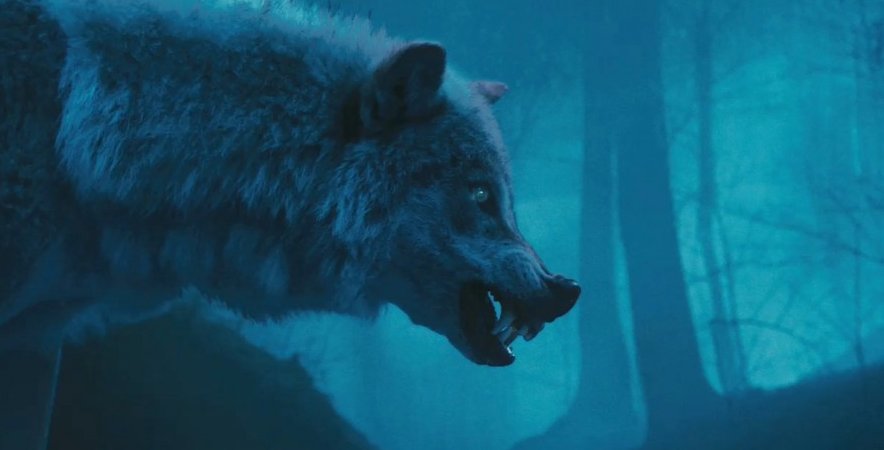
The last time director Dominic Sena teamed with Cage was for the Gone in 60 Seconds remake, which, along with Swordfish was some pretty obnoxious Hollywood hyperbole. Season of the Witch is a notably more subdued (and cheaper, with a mere $40 million price tag) bells and whistleless exercise in genre. Yet whatever failings attributed to the screenplay, the film does succeed with immersive settings and a moody medieval atmosphere. Between the locations used in Hungary, Austria and Croatia and the gritty production design, Sena and cinematographer Amir Mokri render a pallet of grayish overcast and cold ember turquoise clashed with glowing firelight. Fog is used effectively during a night attack by demon wolves and a sequence involving a rope bridge over an impossible chasm is realized with wonderful matte painted dimension. There’s even a certain D&D feel to the way our heroes progress through rounds of peril, investigating mysterious places and deciding collectively on the next course of action. The film’s rather admirably methodical build-up is somewhat undone in the final act, beginning with a slightly nonsensical revelation about The Girl’s true nature. From thereon it settles into part zombie feature and part goofy FX battle, though balanced by one very cool death scene and an honest moment where young Kay is recognized for his bravery.


My town has two movie theaters. One is a 14 auditorium complex newly furnished with XD digital super-screens and Real-D 3D projectors. The other is the older, smaller, bargain bin dive with sticky floors, tacky purple & green trimmings and film reels that snap, pop and crackle. It plays two-to-three month old new releases for a dollar…a dollar! That’s where I saw Season of the Witch, by myself, in a half-sized auditorium peppered with maybe four or five other lowly patrons sitting near the back. Cage hacked away at demon wolves and zombie monks. I ate Goobers. It was fun. 


Wednesday, March 2, 2011

Impossible Movie: The Flash


The biggest problem one faces when making a live action film about a superhero …is that they’re making a live action film about a superhero. It’s a preposterous concept – people who can fly and throw cars and shoot laser beams out of their eyes, often clad in bright spandex. Batman, who is less superhero and more self-made crime fighter, is arguably the easiest to adapt because he has no super powers at all but, instead, must rely on training and specialized gear. He’s entirely human. Iron Man, too, is reliant upon technology; without it he’s just a smartass playboy. The X-Men have mutant powers that are each limited in function, less effective against certain obstacles or enemy mutants and are often conceived more as extensions of personality than solve-all solutions.

By rule of thumb the more powerful and outlandish the superhero the more difficult it is to challenge them and make them semi-credible and sensible--all within and 2 hour average running time. Superman: The Movie managed to slide by with a certain novelty in seeing a man fly and catch helicopters and whatnot. It was a cheery piece that followed in the wake Star Wars, so audiences were still riding high and happy enough just to see such whimsical things up on the big screen for the first time, or at least for the first time with big studio money.

However, looking back, the film no doubts commits one of the lamest deus ex machinas in cinema history when its title hero brings Lois Lane back from the dead by rewinding time via reversing the rotation of the Earth. This is a prime example of superheroes translating to the big screen with silly results. Don’t get me wrong, Superman: The Movie succeeds on charm, but it wasn’t until the sequel that audiences were treated to something a bit more compelling when fellow Kryptonians, General Zod and his cronies, busted out of the Phantom Zone and gave Supes a run for his money.

Superman Returns suffered nary the same fate only without the protection of being an original; it’s plainly disconnecting when the protagonist can solve a crisis (a giant Krypton-infected land mass) simply by lifting it from the ocean and launching it into outer space, although the earlier scene where he rescues a nose diving passenger plane is pretty exciting. When it came time for “smashing!” both Ang Lee’s The Hulk and its reboot The Incredible Hulk impressed with what can only be described as state-of-the-art exercises in FX disaster and rampage. Beyond that, how much danger can we feel for a character so indestructible and so completely meta-human?


Next summer Hollywood will try its hand at two more outrages comic book classics, Thor and The Green Lantern. To make comprehensive an Asgard demi-God living amongst regular folk or a test pilot turned intergalactic do-gooder who can project goopy, green glowing abstractions from his power ring is enough to make any filmmaker’s head spin. How well directors Kenneth Branagh and Martin Campbell, and their respective writing teams, handle these adaptations is dependent upon how well they can integrate their heroes into something relatable for the audience and/or how well they translate the visual iconography of these heroes in action, with tension or unique style, and without making it look downright laughable. No matter their extreme proportions, the common thread shared by most comic book characters is some additional aspect of their nature or origins–at least one underlying theme–that can make for engaging storytelling.

Superman and Thor resonate our yearning to believe in mythic ideals; The Incredible Hulk can be fitted with Frankenstein pathos, whose power is not a blessing but a curse; Captain America embodies the WWII motif and a general sense of nostalgic patriotism; characters like Spider Man, X-Men and the Fantastic 4 are ridden with angsty issues regarding coming-of-age awkwardness and social acceptance. The Punisher is a revenge story, Batman explores psychological content.

No superhero is too niche or esoteric for a good script to flesh-out, downsize, or tweak to make interesting: Doctor Strange could be our first psychedelic, mind-bending superhero movie and Swamp Thing would make a great R-rated fantasy horror à la Guillermo Del Toro. Hell, even Aqua Man can be refashioned into something sleeker and seized for its potential environmental themes. I say all of this, of course, in reference to the one well known superhero who, after some consideration, I think is damn near impossible to adapt into a feature film.


The Flash is one of our oldest superheroes, dating back to January 1940. Since then the mantle has been donned by various characters, a quasi-family of Flashes, linked together by one of the more bizarre storylines of the DC universe involving different Flashes who move between time and exist in multiple parallel dimensions. To simplify, the three names most commonly associated with The Flash are Jay Garrick (the Golden Age), Barry Allen (the Silver Age) and Wally West (the Modern Age); and of those three Barry Allen is arguably the most popular and often referenced. What I find notable about The Flash is just how completely square he is as a character. Allen is not an outcast from another world or a millionaire recluse or a misunderstood freak or a troubled teen.

He has no tragic back story, no real personal issues and doesn’t lead any kind of eccentric lifestyle. He’s a (generically termed) police scientist who suffers a lab accident–doused by lightening struck chemicals–that grant him the powers of super human running speed and matching reflexes. As follows, he sports himself a red body suit and fights crime for Central City. That’s it: Barry Allen, The Flash, red tights, runs fast. ‘Tis true, the comic book chronology of the character(s), spanning some 50 years, is ripe with varying dramatic arcs, victories and defeats, loved ones lost, and even death--and then rebirth. But speaking in terms of a condensed or, more likely, single threaded feature film, the origins, rise and generality of The Flash is all but void of any uniquely thematic angle.


With a little invention I’m sure it wouldn’t be difficult for a couple screenwriters to lay down for a film version some sort of conventional internal conflict or driving motivation to fight crime. So a film-worthy dramatic arc might not be impossible to conjure but finding a way to actually visualize The Flash in all his glory quickly reveals some serious roadblocks. Superman flying is preposterous, but also highly cinematic, with wind and clouds and Earth-curvature vistas.

Spider Man web-slinging between skyscrapers gives audiences a virtuoso thrill, and other mentioned superheroes can be visualized with similar effect. Easiest of all are things like Wolverine’s claws and Captain America’s shield, which, if done right, can render some dynamic action. But The Flash poses a definite problem in this department. Bear in mind that a film version is going to require multiple action sequences, which raises the question: How do you make accessible to the audience said action when the character can, in theory, move faster than the speed of film itself?

On the comic book page all is frozen in still imagery, leaving room for the reader to project the whole of action in their own mind. But film is motion – real space and real time. Therefore The Flash would be nothing more than a trailing red blur. Is this enough to sustain viewers for an entire feature length running time? Also consider that much of the narrative is dictated by geography, and when your hero can cover great distances in mere seconds, plotting, pacing and tension take on a whole new dilemma.

Perhaps utilizing bullet-time effects might help with comprehending The Flash in motion, but it might also run the serious risk of gimmicky, unoriginality and could deflate the very aesthetic of The Flash. Perhaps subtle variations can be explored, finding a happy medium where we can experience The Flash’s super speed field from his point of view but also from eyes of an average pedestrian. I don’t know.

Another keen point of interest in this particular DC universe is The Flash’s arch nemeses known as The Gallery of Rogues. They are united band of criminals that include Mirror Master, The Trickster, The Pied Piper and Captain Boomerang. Never mind them; it is the leader of The Rogues that has the most potential. His name is Leonard Snart, aka Captain Cold (a precursor to Mr. Freeze), who is possibly even simpler than The Flash. Having mastered cyclotron ‘absolute zero’ technology, Cold devised what is simply referred to as a cold gun, which fires an energy beam that, you guessed it, freezes enemies – a proven counter defense against The Flash. But Captain Cold is not some maniacally laughing psychopath. Stoic, dignified, honor-bound and highly ethical, Cold does not believe in senseless violence, kills only out of necessity and still feels remorse afterwards. The guy even enforces a no-drug rule over his Rogues! In an age when movie villains have become such disturbing agents of chaos or corruption, Captain Cold embodies a kind of old fashioned lawful evil. This brings up a larger issue anyhow where the totality of The Flash seems the product of a bygone era when a brightly colored, straight-laced superhero that can go *zoom!* was more than enough to captivate the minds of young boys. I wonder if the material is just too naïve for today’s snarky-to-cynical audiences.

Could they make a moody, self-loathing Flash movie? Should they? I’m not a comic book nerd or collector. I read them casually from time to time before discarding them entirely. It was a glancing image of The Flash, a striking one indeed, that got me thinking on the subject to begin with. I personally find the anachronistic nature of the The Flash rather charming, but, technically, am still not sure how one could pull it off as a motion picture.